

Ultralife’s infographic helps engineers select reliable and safe batteries
Global battery manufacturer Ultralife Corporation has released a new infographic designed to help engineers, product designers and original equipment manufacturers better understand how to select reliable and safe battery systems for portable applications. As electronic devices become more widespread across consumer, industrial, medical and defense markets, the infographic reinforces a critical message: the battery must be treated as an integral part of the overall system – not simply as a power source. The infographic is available as a free download.
The guide highlights how real‑world batteries behave differently from laboratory power supplies, a distinction that can significantly impact device performance and safety. In practical applications, engineers may encounter voltage drop under load, startup current surges, internal resistance losses, temperature sensitivity and long‑term aging effects – particularly when battery quality or system integration is inadequate.
A central theme of the infographic is the importance of starting with clear electrical requirements. Engineers are encouraged to define operating voltage range, peak current demands including surges, standby drain and total energy requirements. These parameters directly influence battery size, runtime and end‑of‑life performance, and are foundational to a successful design.
The infographic presents common battery options, such as rechargeable lithium‑ion, lead‑acid and lithium iron phosphate, along with non‑rechargeable lithium primary cells, and highlights the trade‑offs each makes in terms of performance, size, weight, lifespan and safety. No single chemistry fits every application, underscoring the need for a design‑specific approach.
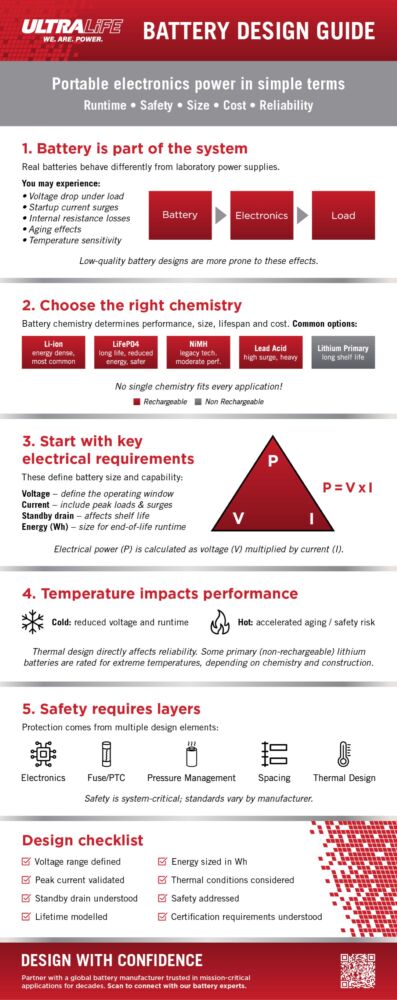
Temperature effects are another critical consideration. Cold environments can reduce voltage and available runtime, while elevated temperatures accelerate aging and increase safety risks. However, these impacts can be mitigated through battery construction, chemistry selection and thermal design. Some batteries, particularly certain primary (non-rechargeable) lithium chemistries, are specifically engineered and tested for reliable performance across extreme temperatures.
Safety is presented as a layered, system‑level requirement, rather than a single feature. The infographic emphasizes that effective protection comes from a combination of electronics, thermal design, spacing, pressure management and protective components such as fuses or positive temperature coefficient (PTC) devices. Battery quality and manufacturer standards are highlighted as important contributors to overall system safety and reliability.
“This infographic is designed to help engineers think more holistically about battery systems,” said Neil Oliver, Technical Marketing Manager at Ultralife Corporation. “In real applications, batteries are exposed to electrical, thermal and mechanical stresses that don’t exist on the benchtop. For decades, Ultralife has designed and manufactured power solutions for mission‑critical applications where performance, safety and reliability are fundamental, and this guide reflects the design principles behind that approach.”
The infographic concludes with a concise checklist for engineering teams designing in a new battery, helping reduce risk, improve reliability and avoid costly late‑stage redesigns.
To learn more about battery system design considerations, download the infographic for free.
For additional information on Ultralife’s high‑quality power solutions for applications including defense, medical and subsea systems, visit https://ultralifecorporation.com/.