~ Custom ICs power precision and reliability in patient-focused devices ~
American physician, Francis Peabody, famously said that “the secret of the care of the patient is in caring for the patient”. While this statement still holds true, how care is delivered is changing. Today, healthcare professionals are fusing science and technology to advance patient-centric care models, with wearable and implantable devices at their core. Here, Ross Turnbull, Director of Business Development at application-specific integrated circuit (ASIC) manufacturer, Swindon Silicon Systems, explains how custom ICs help make these devices safe, reliable and long-lasting.
In line with the wider digital revolution, Healthcare 4.0 introduced automation, cloud-based health data systems and AI-driven hospital workflows to medical settings. Despite enhancing efficiency and connectivity, these advances remained largely-system focused rather than patient-orientated.
However, according to PwC’s 2025 global M&A trends in health industries mid-year outlook, due to changes in the healthcare landscape, healthcare companies are beginning to turn their attention to how they can utilise digital technologies and new scientific to advance patient-centric care.
Often described as Healthcare 5.0, this shift goes beyond improving legacy processes to establish a new standard of connected, personalised, consumer-centric care. At the centre of this transformation are wearable and implantable devices, such as glucose monitors, cardiac trackers, pacemakers and loop recorders. These technologies deliver continuous health data previously unavailable outside of clinical settings, enabling real-time insights that support earlier diagnosis, personalised treatment, greater patient engagement and reduced pressure on healthcare systems.
Despite their benefits, wearable and implantable devices face significant technical challenges that can jeopardise their performance and reliability.
The heart of medical devices
Sensors form the foundation of wearable and implantable devices, and are critical to translating physiological signals into actionable data. However, to be clinically valuable, these sensors must maintain precision and stability under varying challenging conditions.
Maintaining long-term accuracy requires rigorous calibration and ongoing compensation for signal drift caused by material fatigue, temperature changes, electromagnetic interference or physiological factors. In wearable glucose monitors, repeated wrist motion and sweat can subtly alter readings, while implantables like pacemakers contend with tissue encapsulation and biofouling. These challenges necessitate robust signal conditioning and on-chip compensation to ensure reliable data for informed clinical decision-making.
Power consumption is equally critical. Sensors must balance high-resolution data acquisition with low-energy operation to maximise battery life, often relying on low-power analogue front-end circuits and duty-cycled sampling strategies.
Integrating multiple sensors into a single device introduces more complexity. For example, advanced cardiac monitors may combine accelerometers, ECG electrodes and oxygen saturation sensors in a compact wearable patch. Designers must minimise crosstalk, synchronise data streams and ensure signal conditioning preserves fidelity, as even slight misalignment can distort vital metrics, such as heart-rate variability or oxygen saturation trends.
Mitigating these challenges requires application-specific solutions that can deliver the necessary precise signal conditioning, data conversion and power efficiency.

Optimising performance
ASICs are bespoke chips, designed to meet the precise needs of a specific application. In the context of wearable and implantable medical devices, they deliver the optimisation required by sensors.
One of their key advantages is the ability to embed calibration, self-test and compensation functions directly into the silicon.
Traditional sensor calibration can be complex, requiring manual adjustment or additional hardware to maintain accuracy over time. By integrating these functions on-chip, ASICs enable continuous, automated correction throughout the device’s life. On-chip digital calibration routines compensate for sensor changes through offset correction, gain adjustments and reference-signal comparison. At the same time, built-in self-test functions provide real-time diagnostics to detect degradation or failure before it affects performance.
Ultra-low power design is another critical advantage. ASIC front ends can balance high signal fidelity with energy efficiency, outperforming off-the-shelf ICs in continuous monitoring and long-term reliability. Techniques such as sub-threshold operation, dynamic voltage and frequency scaling, duty-cycled sampling and energy-efficient analogue front ends capture high-resolution data while minimising current draw. This is particularly vital for implantable devices, where replacing a battery may require invasive procedures.

A digital illustration of human chest with semi transparent view showing glowing pacemaker inside heart, highlighting medical technology
ASICs also enable compact, multi-sensor integration. By tailoring the chip layout to each application, designers can minimise crosstalk, optimise routing and improve electromagnetic and thermal management. Combined with on-chip multiplexing, synchronised timing and programmable filters, this ensures multiple data streams remain accurate, allowing ECG electrodes, accelerometers and oxygen monitors to coexist in compact wearables or less invasive implants.
Finally, ASICs support long-term reliability and supply security. Unlike off-the-shelf components, ASICs reduce the risk of obsolescence, guarantee consistent electrical characteristics and allow manufacturers to meet the demanding lifespans of medical devices, which can exceed a decade.
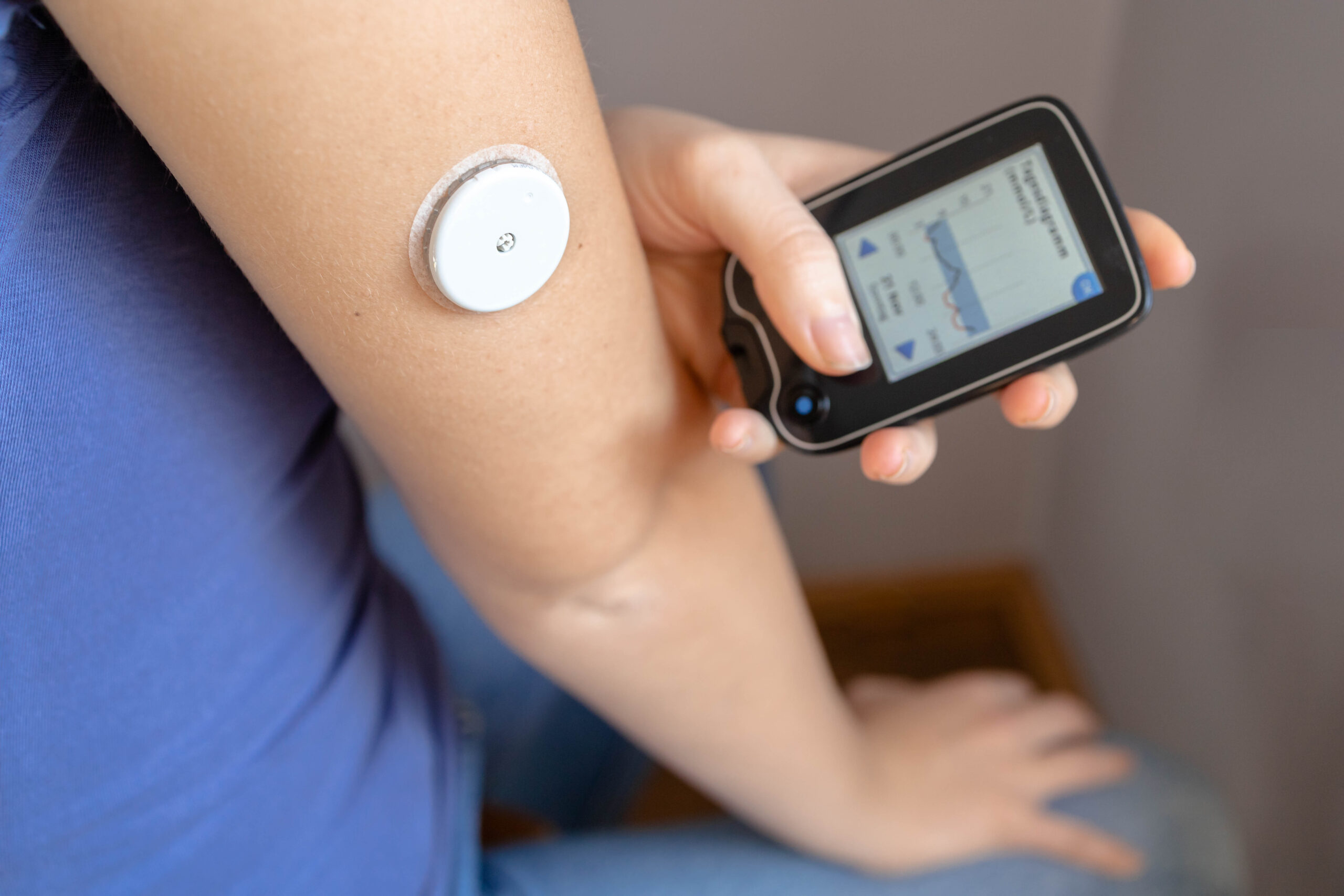
Girl sitting with sensor glucose patch on her arm looking at the monitor results
Healthcare 5.0 promises a future where care is continuous, connected and tailored to each patient. Realising this depends on sensors that consistently deliver precise physiological data, and on ASICs that optimise their performance. By ensuring accuracy, efficiency and long-term reliability, ASIC-enabled devices empower clinicians and patients with timely insights, supporting smarter treatment decisions and better patient outcomes over a lifetime of care.
Swindon Silicon Systems provides a full turnkey solution (FTK) for ASIC development and manufacturing. To learn how Swindon Silicon can support your next medical project, please get in touch today.